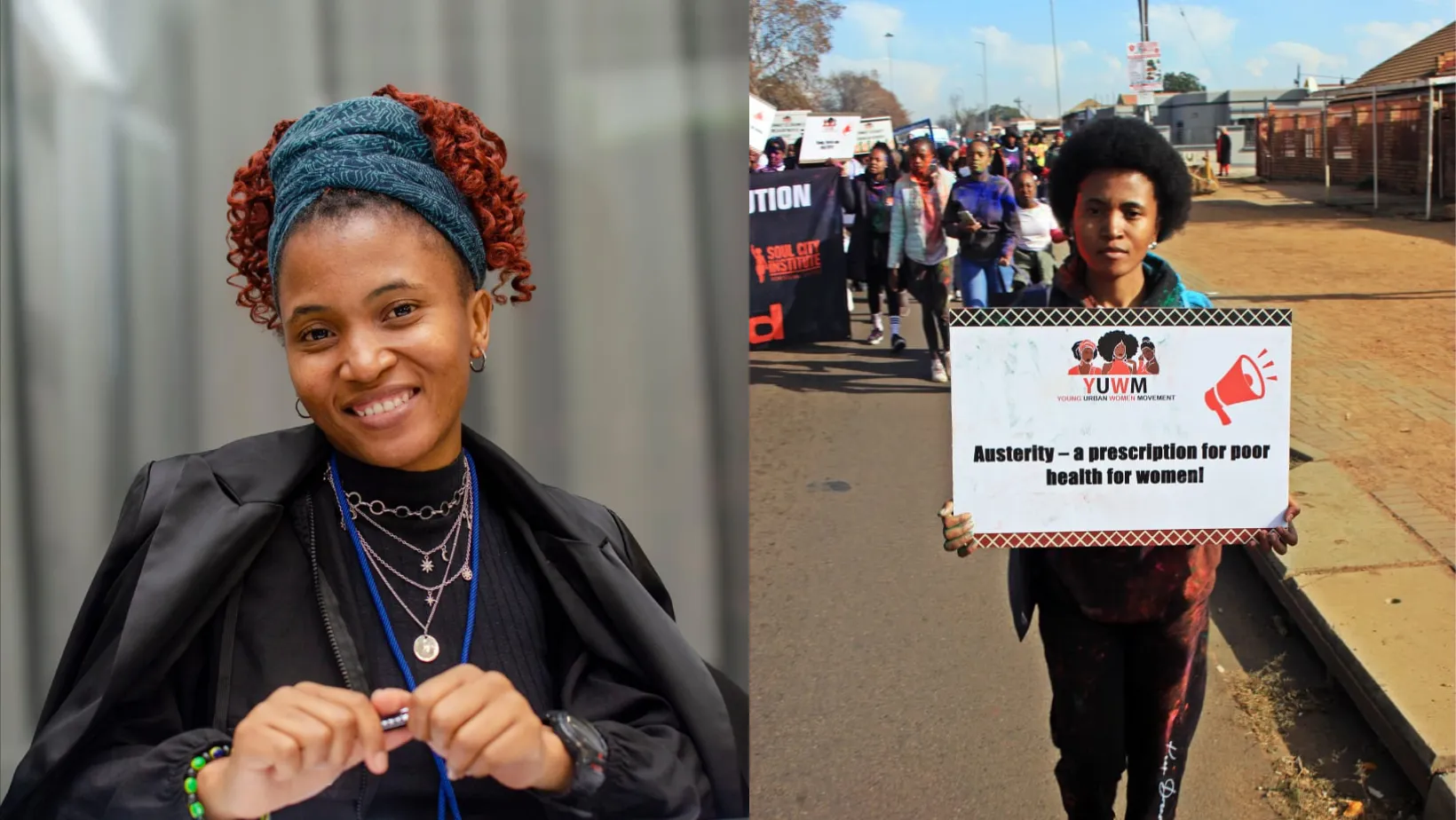
Mamelodi is a vibrant township in the Gauteng province of
South Africa. Like many urban communities across the region, life here moves
with an energetic rhythm. But beneath the surface, a critical life source has
begun to falter. The infrastructure that once consistently supplied water to
families has increasingly come under severe strain, leaving taps dry and
communities in limbo.
"I saw at a young age how we struggled with access
to water," said Lerato, a water science practitioner and Young Urban
Women activist. "One day our communal standpipes just suddenly ran dry.
We relied heavily on rainwater, but rain wasn't consistent."
Lerato’s life, much like that of many South Africans, has
been shaped by a fluid connection between urban spaces and ancestral roots.
Every December, her family would make the annual pilgrimage back home to their
rural province. It was across these dual landscapes that she first witnessed
the harsh realities of water scarcity.
These early experiences did not discourage Lerato, instead,
they ignited a deep curiosity. Some of the most important things she has
learned stemmed from spending hours observing polluted local streams,
volunteering, and asking older residents how the natural landscape had changed
during their youth. She chose to study water science at a tertiary level,
determined to understand the technical mechanics behind the shortages she saw.
"My academic background was just the cherry on
top," Lerato explained. "Everything started when I was a
child."
Across Gauteng's townships, many residents face the same
daily uncertainty. When water cuts hit, the burden does not fall equally.
Lerato watched closely as the systemic failures of local infrastructure
translated into a quiet, heavy crisis within households.
"Women and girls are affected differently during
periodical water cuts, sewage spillages, or even illegal dumping,"
Lerato noted. "They are the ones who carry the burden of
responsibility."
Change entered a new phase when Lerato connected with the
Young Urban Women Movement (YUWM). The movement did not create Lerato’s
ambition, but it provided a collective network where her voice could expand. It
brought together young women to analyze their shared realities through a
socio-economic and political lens. For Lerato, the movement offered something
that technical textbooks had left out: a network of solidarity.
"I would say the Young Urban Women Movement added
that social science aspect of my studies," Lerato reflects. "In
fact, it challenged me a great deal. I've always been the water quality and
monitoring, 'let's take care of our rivers' girlie. And what Young Urban Women
did was challenge my thinking by involving a very critical stakeholder; the
immediate community. That the environment exists with the people in it, so in
order to conserve natural resources, ensure that the people are aware of these
resources and fully understand their role in them. That's where I saw how I
could fit into the YUWM."
This network allowed her to ground her scientific data in
the raw, lived experiences of township women. Seeing other young activists
standing firm in their truth encouraged Lerato to step fully into her power as
a leader.
"It allowed me to speak about the water woes we've
experienced in some parts of the province," she explained with a smile.
"Seeing the network of activists within the movement has really encouraged
me to not hold back."
Lerato decided to bring this dual expertise of scientific
training and community reality into formal spaces. Before joining the program,
Lerato was already a trained scientist who knew of the formal governance
structures in her field. In fact, she had already set her sights on the South
Africa Youth Parliament for Water committee entirely on her own merit.
"I knew of the committee way before the YUW
program," Lerato said. "YUW came afterwards, and it helped me
build on my confidence as an activist."
She was recently selected to lead the Gauteng team for the
Youth Parliament for Water. Where policy conversations are typically dominated
by engineers and politicians talking about budgets and infrastructure, Lerato
is introducing a completely different dataset: the lens of unpaid care work.
Her strategic focus for the Youth Parliament for Water centers
on turning everyday household survival into political evidence. “Through my
involvement in the YUWM as well as other environmental spaces, I have learned
that these experiences are often missing from formal policy,” she said.
She highlights the
specific, unquantified labour women perform during environmental crises:
“They (women) are the ones who had the burden of
responsibility to care for sick family members, making sure children do not
play near overflowing sewage, queuing for water when the taps have run dry and
still carry the emotional burden of keeping households functioning.”
These systemic insights were sharpened through her dual
identity as a township resident and an active participant in environmental
advocacy spaces.
"In the Youth Parliament for Water, I want to make
sure that conversations about water governance are not only technical, but also
human-centered," Lerato explained. "I want the lived
experiences of various community actors, including young women and girls, to
shape the agenda."
Lerato’s leadership represents a critical shift in how
development and climate adaptation should be approached. Her entry into
governance reflects a wider pattern observed among young women who are claiming
space in policy environments.
Her trajectory highlights an essential lesson that extends
far beyond Gauteng. While many institutions view development assistance through
the paternalistic lens of aid, Lerato’s journey demonstrates that young women
do not need pity, they need structural access.
Supporting approaches like the Young Urban Women Movement
proves that when young women are given resources and spaces to organize,
meaningful leadership emerges natively from the ground up. For organizations
like ActionAid South Africa, continuing to invest in young urban women is a
direct investment in sustainable, long-term climate strategy. These women are
already holding communities together during environmental crises and their
leadership is what connects local ground realities to global climate policy.
Across Africa, where climate variations directly impact
water security, initiatives that amplify local, intersectional leadership offer
a sustainable pathway for true resource transformation. For Lerato, however,
the most profound reflection is not just the political platform she has earned.
It is the lesson she carries for the next generation of girls looking at her
from the streets of Mamelodi, girls who feel that big, intimidating conference
rooms were not built for them.
"I would tell her that I also started as a young
person from the township who simply cared deeply about the environment around
me," she reflected. "You do not need to wait until you feel
'perfect' or fully ready to participate. Start where you are. Leadership grows
through participation. I am evidence of that."
Today, Lerato continues to analyze water systems, lead her
parliamentary team, and challenge formal structures to look at water through a
human face. Her message to the world, and to institutions like ActionAid,
remains clear and uncompromised:
"Investing in young women is not charity. It is a
sustainable strategy," Lerato says simply. "That investment will
continue to create ripple effects far beyond one individual."